
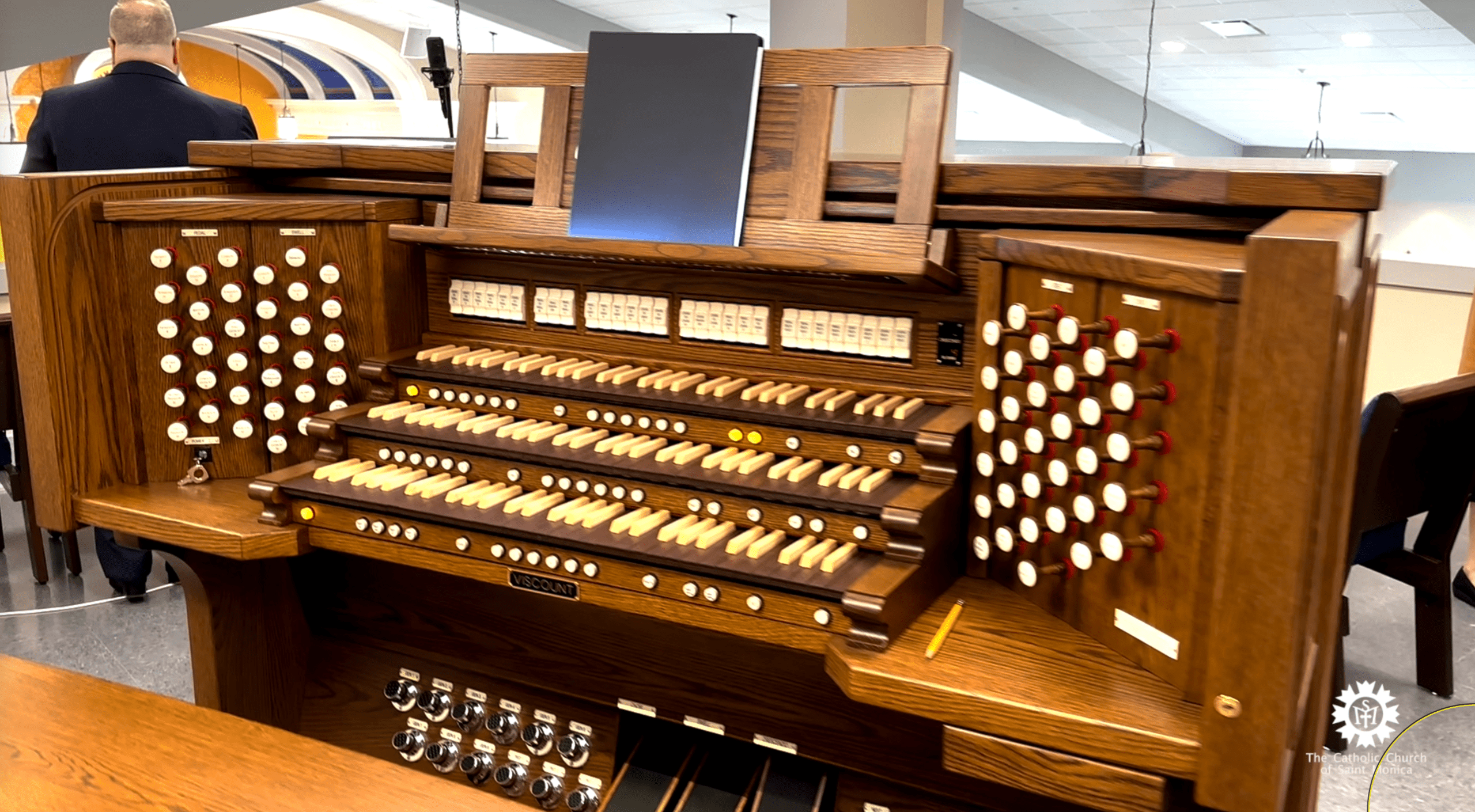
Discover the Church’s musical heritage. Learn to sing. Grow in prayer.
At the Catholic church of St. Monica in Duluth, Georgia, we embrace sacred music as the primary way to lift our voices and hearts to God. Through Gregorian chant, we seek to serve the liturgy and deepen the prayer of our parish. Whether you are discovering chant for the first time, interested in joining a schola, or looking for sacred music concerts and events, we invite you to learn, participate, and experience this tradition with us.
Explore sacred music at St. Monica
Youth Schola
Help your child develop their voice, learn the foundations of sacred music, and grow in faith through singing. Our youth scholae provide musical formation and opportunities to serve the prayer of the parish.
Adult Schola
Deepen your understanding of the Church’s music through study, rehearsal, and service to the liturgy. Explore our adult ensembles and learn about their musical formation and participation requirements.
Become a Cantor
Cantors are selected from participants in one of the adult scholae and must take part in a vigorous training program. Paid cantors must meet a standard of vocal accomplishment and are selected by the Director of Sacred Music.
Friends of Sacred Music
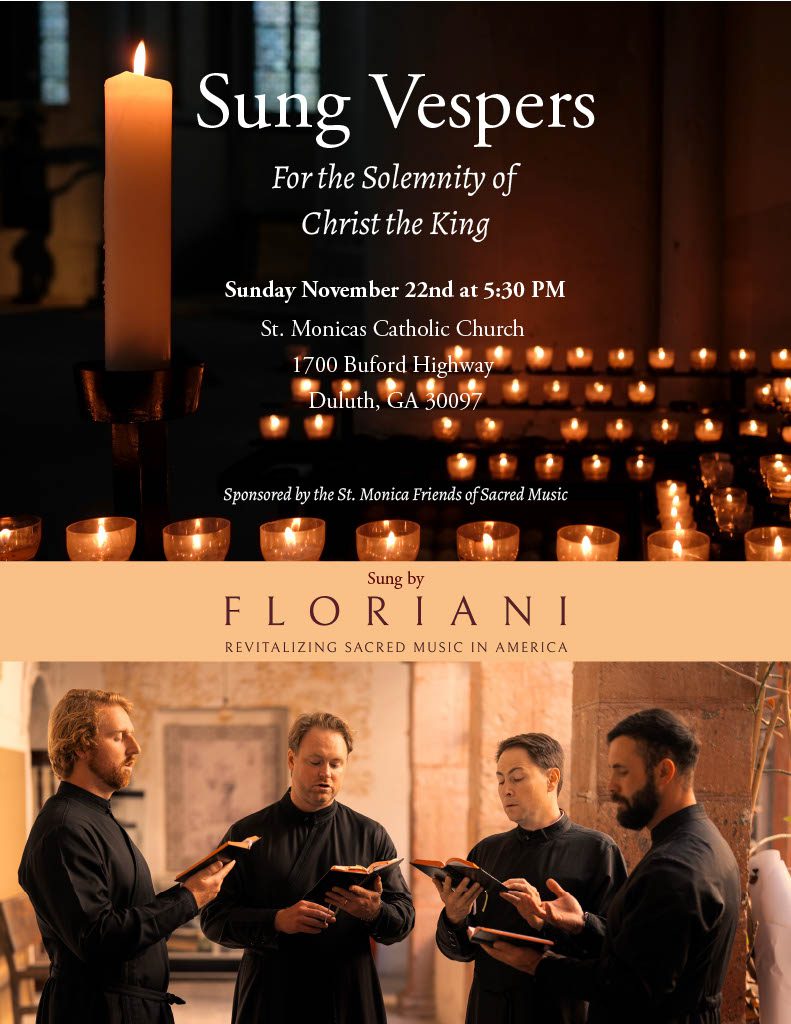
From Vespers and chant to choirs, carols, and organ recitals, Friends of Sacred Music offers opportunities to encounter the beauty and tradition of Catholic sacred music. Hosted by St. Monica Catholic Church, the series brings together visiting ensembles and parish musicians for concerts, sung prayer, and seasonal gatherings. Admission is free.
Donations are graciously accepted to support the Friends of Sacred Music concert and event series. Click here to donate online: https://www.osvhub.com/saintmonicas/giving/funds
Why sacred music matters
Sacred music gives voice to the prayer of the Church. United with the words and actions of the liturgy, it helps us praise God, enter more deeply into the mysteries we celebrate, and pray together as one community. Our musical tradition is something to receive, study, and share. At St. Monica, we seek to preserve its beauty while helping parishioners understand and participate in it.
A treasure entrusted to the Church
The Second Vatican Council describes the Church’s musical tradition as a “treasure of inestimable value.”
Sacrosanctum Concilium, paragraph 112, explains that sacred music belongs intimately to the liturgy and serves the glory of God and the sanctification of the faithful.
Read Sacrosanctum Concilium, Chapter VI
Singing together at Mass
The General Instruction of the Roman Missal emphasizes the importance of singing at Mass, with attention to the abilities of the gathered community.
Paragraph 40 encourages singing by ministers and the people, especially on Sundays and Holy Days of Obligation. Paragraph 41 affirms Gregorian chant’s particular place in the Roman liturgy while also allowing other forms of sacred music suited to the celebration.
Read GIRM, Chapter II, paragraphs 40–41
Pope Leo XIV on sacred music
“To sing and play music during the liturgy is to pray.” — Pope Leo XIV, General Audience, August 19, 2026
Pope Leo reminds us that singing helps unite our hearts with one another and with God. Learning the Church’s music is an invitation to participate more fully in her prayer.
Read Pope Leo’s reflection on sacred music
Sing with the Pope Instagram: https://www.instagram.com/musicasacra.va/reels/
Our schola cantorum: a school of singing and discipleship
The words schola cantorum mean “school of singing.” At St. Monica, that name expresses our commitment to musical learning rooted in faith.Our singers study the music of the Church, develop their voices, and prepare to serve the liturgy with care and reverence. This formation calls us to grow in our knowledge of Christ and to offer our best in the worship of God.
As Director of Sacred Music Jacob Temple explains: “We are more than students, we are disciples; not merely of music, but of Christ Himself.”
A reflection from our Pastor
Father Jack Durkin shares his personal journey of learning Gregorian chant and shares insight on the timeless and time-tested beauty of sacred music.
Listen to Fr. Jack’s thoughts on learning Gregorian chant
“Singing with purpose”
Jacob Temple reflects on the schola cantorum as a school of singing and discipleship, where musical formation deepens faith and prepares singers to serve the liturgy.
Read Jacob’s reflection on the schola cantorum
Sacred music resources for learning and practice
You can begin learning chant without knowing Latin or how to read music. Start by listening, follow a short phrase, and become familiar with the words and melody. These resources offer a starting point for anyone who wants to sing more confidently at Mass or explore the Church’s musical tradition.
Choose a starting point that matches your interests. You can practice music used at St. Monica, learn the basics of chant notation, or explore a wider collection of sacred music.
Sing the Mass!
Practice the Ordinary of the Mass and seasonal Marian anthems with resources selected for our parish.
Visit Sing the Mass!
Understanding why we chant the Creed
Explore the place of the sung Creed in our parish’s prayer and continue with the Credo III practice resources.
Read Why We Chant the Creed
Get to know the notation
The square notes and musical signs used in chant may look unfamiliar at first. Learn how the four-line staff, clefs, and note patterns help you follow a melody.
- https://www.catholicliving.net/gregorian-chant-notation-getting-started/ [Interactive Blog series]
- CMAA: Guide to Neumes [downloadable PDF]
- Beginner’s Guide to Gregorian Chant: Free Workshop! [Video]
- Introduction to Gregorian Chant: Lesson I – The Basics [Video]
- Video on Intervals & Solfege [Video]
Learn more about Gregorian Chant
Discover the history of Gregorian chant, how its distinctive notation developed, and its place in the prayer of the Church. These resources offer an introduction to the tradition behind the music you hear at Mass.
- Gregorian Chant: A Guide
- History of Gregorian chant notation
- https://www.catechist.com/praying-gregorian-chant/
- CMAA: Liber Usualis introduction [downloadable PDF]
Additional beginner chant resources
Explore introductory lessons, notation guides, and pronunciation resources from established sacred music organizations
- https://www.saintmeinrad.edu/sacred-music/resources/
- https://www.gregorian-chant-hymns.com/guides/
- https://spiritualcantor.com/gregorian-chant-resources/
- https://music2.princeton.edu/chant_html/
- https://www.ccwatershed.org/gregorian/
- https://sacredmusiclibrary.com/
- https://gregorianchantacademy.com/
- https://gregorian-chant-hymns.com/
- Chant lessons YouTube playlist
Questions about sacred music
Do I need musical experience to begin learning chant?
Not at all! You can start by simply listening and reciting what you hear. Our introductory resources can help you become familiar with the music before you begin studying notation.
Do I need to know Latin?
You do not need prior knowledge of Latin to begin exploring the resources. Practice recordings can help you learn the words gradually.
Can I learn without joining a schola?
Yes. These resources are available to help parishioners and visitors learn about sacred music and participate more confidently in worship.
How do I find the right schola for myself or my child?
Explore the Youth Schola or Adult Schola page, then contact Jacob Temple to discuss the appropriate ensemble and its requirements.
Take your next step in sacred music
Have a question about learning chant, joining a schola, or Friends of Sacred Music?
Contact our Director of Sacred Music.
Jacob D. Temple, MM, CAGO
Director of Sacred Music
jtemple@saintmonicas.com
678-584-9947 ext. 130